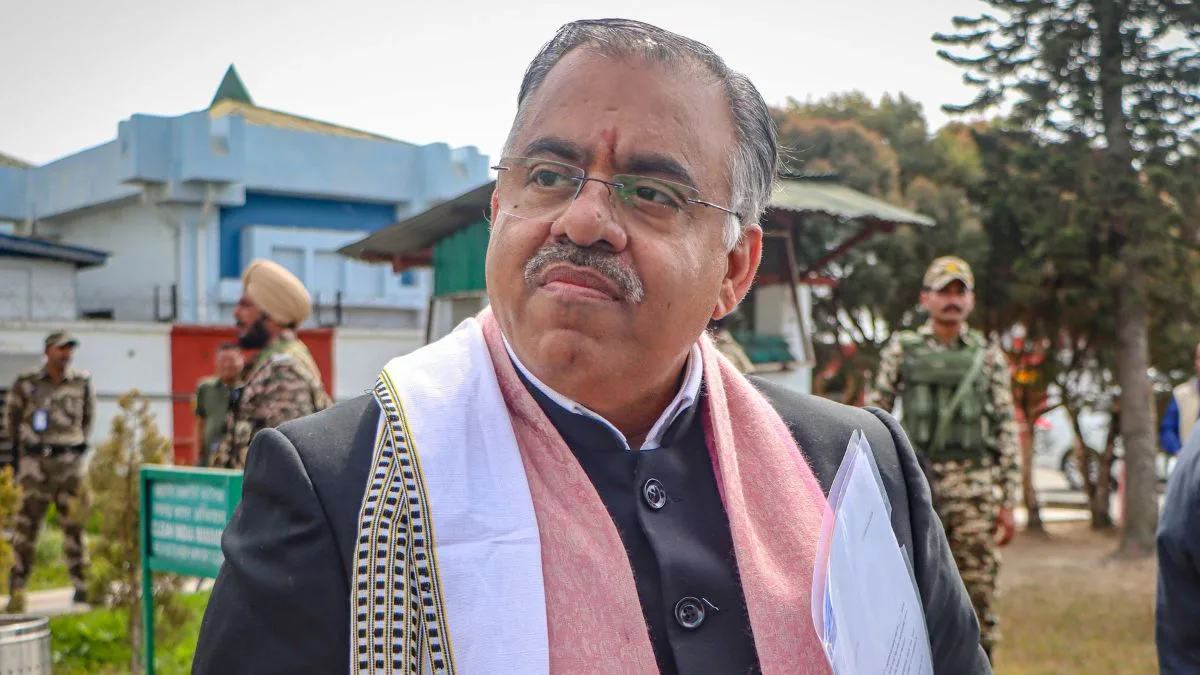
Rajya Sabha polls: Tarun Chugh named BJP candidate from MP, Ravneet Bittu missing from list
The latest candidate line-up is viewed by political analysts as a calculated move to balance organizational experience with emerging regional equations.
The ruling BJP’s performance on Tuesday across 15 municipal corporations in Gujarat — including Surat, Rajkot, Vadodara, Bhavnagar, and Ahmedabad — validated the party’s continued dominance in the home state of Prime Minister Narendra Modi and Home Minister Amit Shah.





BJP supporters holding party symbol flags (File Photo: ANI)
The ruling BJP’s performance on Tuesday across 15 municipal corporations in Gujarat — including Surat, Rajkot, Vadodara, Bhavnagar, and Ahmedabad — validated the party’s continued dominance in the home state of Prime Minister Narendra Modi and Home Minister Amit Shah.
The results of the elections, held on Sunday for 15 municipal corporations, 84 municipalities, 34 district panchayats, and 260 taluka panchayats, assume significance when viewed in the context of the next Assembly elections in the state, due next year.
Advertisement
These elections — one of the largest electoral exercises in the state ahead of the Assembly polls — covered over 4.18 crore eligible voters, according to reports.
Advertisement
The BJP continued with its tight grip in urban local bodies, in what is being described as the biggest ever sweep in MC.
In Ahmedabad, it secured around 158 out of the 192 seats in the MC, a clear indication of its organisational skills. In Surat, it won around 115 out of the 127 seats. The AAP could manage only four seats and the Congress one seat. The Surat result specifically dealt a blow for AAP, which performed quite well in the last elections.
The saffron sweep in the 2026 Gujarat local elections, especially in urban centres, indicates a consolidation of saffron power in the state. The party’s chief opponents — the Congress and the AAP — were pushed to distant second and third positions, securing either in single-digit figures or a nil.
AAP’s limited presence beyond a few seats in Surat and Jamnagar, and Congress’s scattered gains, point to a widening gap in the state’s political landscape. The BJP also emerged as the dominant force in rural local bodies.
While the Congress performed comparatively better in rural areas, AAP’s strongest showing came in Gujarat’s tribal belt.
According to reports, the Arvind Kejriwal-led party put up a strong performance in the tribal belt of the Narmada district, winning control of four taluka panchayats — Dediapada, Garudeshwar, Sagbara, and Chikda — marking its growing influence in the region. However, it suffered severe setbacks in urban centres. For instance, in the Surat Municipal Corporation, where AAP state general secretary Manoj Sorathiya lost.
Meanwhile, the Asaduddin Owaisi-led AIMIM also found a tiny silver lining in some areas, particularly in Bhuj and Bharuch in the Kutch district, establishing a minor but notable presence in an otherwise BJP-dominated civic election. Owaisi campaigned actively, addressing public gatherings where he criticised the BJP over issues such as the Uniform Civil Code and urged voters to consider alternatives.
Observers say AIMIM’s performance in Bhuj and Bharuch marks an interesting entry into Gujarat’s local body politics. It also suggests that the party managed to convert targeted campaigning into electoral gains.
Voting was held for the first time in nine newly created municipal corporations—Navsari, Gandhidham, Morbi, Vapi, Anand, Nadiad, Mehsana, Porbandar, and Surendranagar.
Advertisement